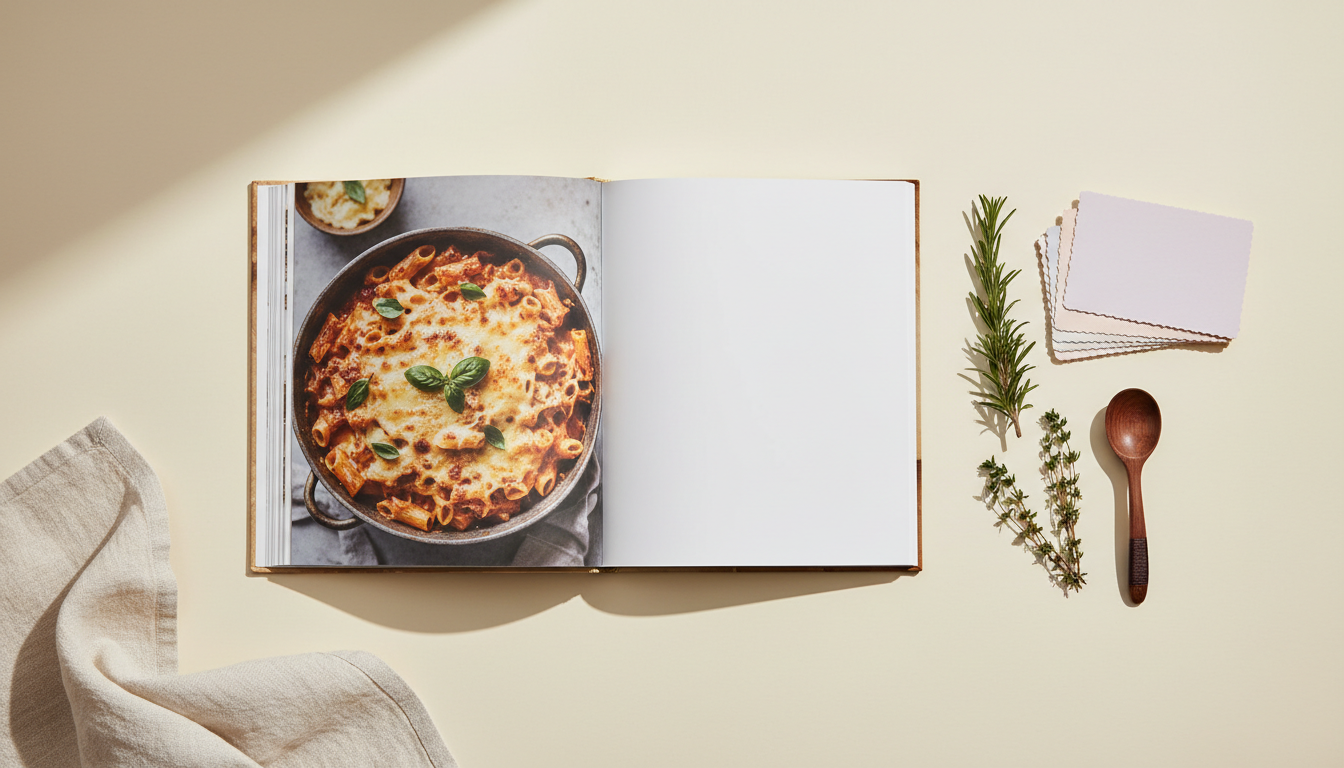
Everyone who cooks well hears it eventually: “you should put these recipes in a book.” And they're right — a cookbook is one of the most loved, most gifted, most kept kinds of book there is. But publishing one is not the same project as publishing a novel or a memoir. A cookbook is a book, a photography project, and a small manufacturing decision rolled into one, and the advice that works for text-only books will quietly steer you wrong on all three. We've published more than 1,200 books since 2017, cookbooks among them, and this guide is the same plain walkthrough we give aspiring cookbook authors on the phone — the three real paths, the steps in order, and the costs nobody mentions until you've already committed.
What makes a cookbook different from every other book
Three things, and every one of them costs either money or planning:
- Recipe testing. A novel can survive a clumsy sentence; a recipe that doesn't work loses the reader forever. Serious cookbook authors test every recipe multiple times, ideally in someone else's kitchen with someone else's oven, and write measurements a stranger can follow exactly.
- Photography. Readers buy cookbooks with their eyes. You don't strictly need a photo for every recipe — plenty of classic cookbooks are text-forward — but the covers and interiors that sell today lean on bright, high-resolution food photography, and producing it is a real line item.
- Full-color printing. This is the quiet budget-killer. Print-on-demand services charge per page, and color pages cost several times what black-and-white pages cost. A 200-page full-color paperback can carry a per-copy printing cost higher than the cover price of many novels — run your exact page count through Amazon KDP's printing cost calculator before you design the book, not after.
Keep those three in view and the rest of the path looks like any other book's: choose your route, produce the book professionally, distribute it, and tell people it exists.
Path 1 — Traditional cookbook publishing
Here's the part that surprises most people: traditional publishers don't buy finished cookbooks. They buy proposals. A cookbook proposal is a pitch document — your concept and angle, a proposed table of contents, a handful of polished sample recipes, an analysis of competing titles, and, crucially, your platform: the blog, social following, restaurant, or community that proves readers already want food from you. An agent shops that proposal to publishing houses; if one bites, you write and test the full manuscript with their editorial team, often over a year or more.
Be clear-eyed about what this path rewards. Publishers acquire cookbooks largely on the strength of the author's existing audience, because that's what sells them. If you have a food blog with real traffic or a devoted local following, a proposal is worth writing. If you're starting from a family recipe box and no platform, the honest odds of a traditional deal are long — not because your food isn't good, but because nobody in the acquisition meeting can see it yet. Our general publishing guide covers querying agents if you want to try this road first.
Path 2 — Self-publishing your cookbook
Self-publishing puts you in charge of everything, and for cookbooks “everything” is a longer list than usual: recipe testing, headnote writing, photography, licensing or shooting every image, full-color interior layout (a genuinely specialized design skill — recipes have to flow across spreads, never splitting an ingredient list from its steps), cover design, ISBN, metadata, and marketing. Platforms like Amazon KDP make the upload free, and print-on-demand means you never hold inventory.
The strategic decision is format, and it's where the color-printing math bites:
- Full-color print is the classic cookbook experience, but per-copy print costs are high, which squeezes your royalty or pushes your price up. It suits shorter books, premium pricing, or authors who mostly sell in person.
- Black-and-white or limited-color interiors print far cheaper and suit text-forward books — think of the beloved community and church cookbooks that sell for decades without a single photo.
- Digital formats — a PDF or eBook — cost nothing to deliver, keep every photo in full color, and are how many food bloggers profitably sell recipes today. Amazon's eBook royalty is 70% on titles priced $2.99–$9.99, and print paperbacks pay roughly 60% of list price minus the printing cost — which is exactly why the printing cost matters so much.
The honest version: self-publishing a cookbook well is two skilled projects — a tested manuscript and a designed, photographed object. Authors who respect both produce books that sit comfortably next to traditionally published titles. Authors who skip photography planning and interior design are usually disappointed at exactly the moment the proof copy arrives.
Path 3 — Assisted publishing: hire the team, keep the rights
The middle path — and the one we run at USA Publishing House — is assisted publishing: you keep 100% of your rights and royalties like a self-publisher, but a professional team does the production work — editing your recipes and headnotes for clarity and consistency, designing a cover that competes in its category, laying out the interior so every recipe reads cleanly, registering the ISBN, and distributing to Amazon, Barnes & Noble and 20+ platforms. Our packages are one transparent price, published on our pricing page, and nothing publishes without your written approval.
The same two rules that protect you from bad actors anywhere in publishing apply doubly to cookbooks, where production budgets are bigger: keep 100% of your rights and royalties, and get one total price in writing. A company that wants a share of your royalties, or whose “investment” grows with every phone call, has answered your question about them.
The steps, in the order that saves you money
- Define the concept narrowly. “My recipes” is a collection; “weeknight Persian cooking for American kitchens” is a cookbook. A sharp angle drives every later decision — and the title, cover, and marketing write themselves.
- Choose your format early. Full color, limited color, or text-forward? Print, digital, or both? This decision sets your photography needs and your page budget, which is why it comes second, not last.
- Test every recipe — then have someone else test it. Write ingredients in order of use, give visual doneness cues alongside times, and state yields honestly. A recipe another cook can't reproduce is a defect, not a style.
- Write the connective tissue. Headnotes, chapter openers, and your story are what make a cookbook yours — and legally, they're also the most protectable part of it (more on that below).
- Solve photography deliberately. Shoot it yourself with natural light and a consistent style, hire a professional for a concentrated day or two, or design a text-forward book that doesn't depend on photos. All three work; drifting between them doesn't.
- Edit, design, and format professionally. Recipe editing is its own discipline — consistency of units, terms, and structure across a hundred recipes — and color interior layout is not a template job. This is the stage where hiring help pays for itself.
- Publish and distribute. Upload to KDP and IngramSpark, or let your assisted publisher handle distribution. Order a printed proof and check every spread before you approve anything.
- Market where food lives. Cookbooks sell on sight: short recipe videos, local signings, farmers-market tables, gift-season pushes, and the communities where your cuisine already has fans.
What publishing a cookbook costs
Honest ranges, not quotes — your manuscript's length, photo count, and format move every line. Treat these as planning figures:
| Line item | Typical range | What moves it |
|---|
| Recipe & copy editing | $500–$3,000 | Recipe count, how consistent your drafts are |
| Photography | $0–several thousand | DIY vs. hiring a pro; number of finished shots |
| Cover + full-color interior design | $1,000–$5,000 | Page count, photo density, print + eBook files |
| ISBN | $125 (single, via Bowker) | Bundles cost less per ISBN; assisted packages include it |
| Per-copy color printing | Set by page count | Check KDP's printing calculator — color pages cost several times B&W |
If you'd rather see the whole picture in one place, our line-by-line cost breakdown covers every version of the math, and our packages bundle the production work into one flat price. Authors in Utah, Georgia, and every state in between get the same public numbers.
Are recipes copyrighted? The answer every cookbook author needs
This question stops more cookbook projects than money does, so here is the plain version. Under U.S. Copyright Office guidance, a mere listing of ingredients is not protected by copyright. Facts and methods — that bread needs flour, water, salt, and yeast — belong to everyone. What is protectable is substantial literary expression: your directions as you wrote them, your headnotes and stories, your photographs, and the selection and arrangement of the collection as a whole.
Practically, that cuts both ways. You may absolutely publish your version of classic dishes — every lasagna in print descends from someone else's lasagna — but write the instructions in your own words and never copy another author's prose or images. And it means the most valuable, most protectable things in your cookbook are exactly the parts only you can write: the voice, the stories, and the photos. Invest there.
Five cookbook mistakes we see first-time authors make
- Designing before deciding on format. A book laid out for full color can't cheaply become black-and-white later. Format first, design second.
- Skipping outside recipe testing. You unconsciously fill gaps in your own recipes. A stranger's kitchen is the only honest test.
- Pricing without checking print cost. More than one author has priced a color paperback below what each copy costs to print. Run the calculator first.
- Mixing photo styles. Twelve beautiful photos in three different styles read as amateur; forty consistent ones read as professional.
- Signing away rights or royalties. No legitimate service needs a share of your book to produce it. One price, in writing, rights stay yours — on this we never bend.
Ready to turn the recipe box into a real book?
Tell us what you're cooking and where the manuscript stands. In about 20 minutes, a real consultant will walk your format options and your exact written price — whether or not you choose us.
Book a free consultation
Questions cookbook authors ask us
How much does it cost to publish a cookbook?
It depends on the path and the format. Traditional publishing costs you nothing if a publisher acquires your proposal. Self-publishing a photographed, full-color cookbook typically runs from several hundred to several thousand dollars across editing, photography, and design. Assisted publishing bundles the production into one flat fee — our packages start at $699 — and full-color printing adds a per-copy cost set by your page count. See our cost breakdown for the complete math.
Is a recipe protected by copyright?
A mere listing of ingredients is not protected, per U.S. Copyright Office guidance. Your written instructions, headnotes, stories, photographs, and the book's overall selection and arrangement can be. Write everything in your own words and never reuse another author's text or photos.
Do I need a photo of every recipe?
No. Photo-forward books are the current retail standard, but text-forward cookbooks with few or no photos have sold well for generations and print far more cheaply. What matters is choosing one approach deliberately and executing it consistently.
How long does it take to publish a cookbook?
With the manuscript and photos ready, self or assisted publishing typically takes one to four months to a live listing. Recipe testing and photography add whatever time you give them — often the longest phase. Traditional publishing usually takes one to three years from proposal to shelf.
Can I publish a family or church cookbook this way?
Yes — these are some of the most rewarding books we produce. A text-forward or limited-color format keeps printing affordable, print-on-demand means anyone can order a copy forever, and the collection becomes a permanent family record instead of a spiral-bound binder that slowly disappears.
Sources & further reading: recipe copyright guidance is from the U.S. Copyright Office (Circular 33, “Works Not Protected by Copyright”). Royalty figures are Amazon KDP's published terms (70% / 35% eBook tiers; ~60% of list minus printing on paperbacks); per-copy print costs come from KDP's own printing cost calculator. Cost and timeline ranges reflect USA Publishing House's work with 1,200+ authors since 2017.
USA
Written by the editorial team at
USA Publishing House, an assisted book publisher based in Norcross, Georgia, helping authors bring books to print since 2017. Have a question this didn't answer? Call
(229) 518-4453, 11am–8pm ET, Monday to Friday.